- Sooner Safer Happier
- Posts
- Ways of Working Nudge
Ways of Working Nudge

Jon Smart
January 20, 2026
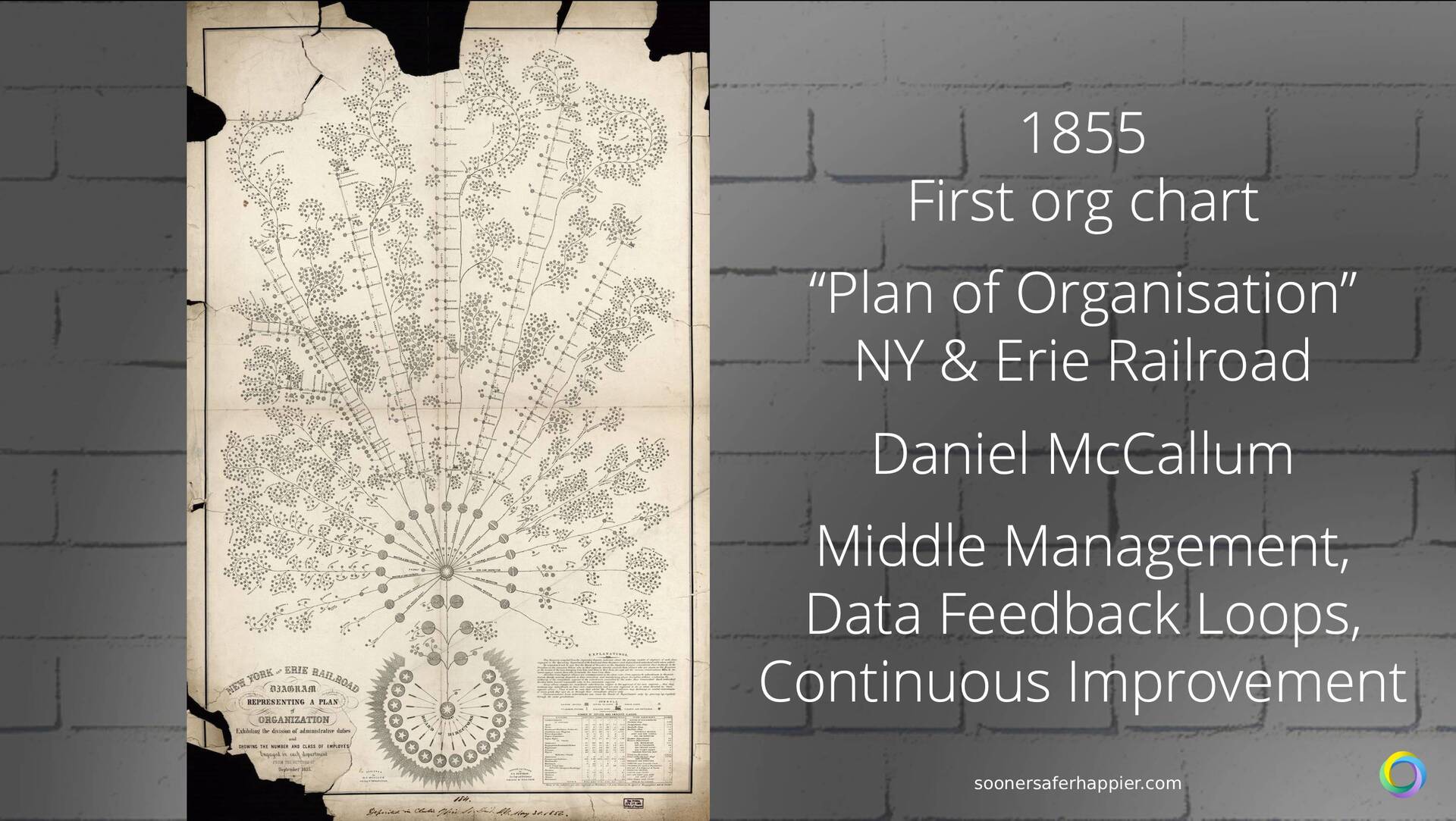
The world's first known org chart dates from 1855 and has the company directors at the bottom, not the top! It is drawn to represent a plant, a living organism, with the railroad lines representing branches of the organism and people as flowers, or nodes, of the plant. The company directors are visually supporting the organisation. This is totally appropriate to represent the charting of an organisation, as an organism.
Other management innovations introduced by Daniel McCallum at the NY & Erie Railroad include:
▶️ Middle management: due to the long distance of the railroads, going all the way back to the Head Office to make a decision would have taken a very long time. McCallum has the first known writing on middle management. In the 1855 Annual Report he articulates a number of management principles. This includes:
"(1) A proper division of responsibilities
(2) Sufficient power conferred to enable the same to be fully carried out, that such responsibilities may be real in their character".
In 1855, to optimise for outcomes, McCallum had empowered middle management, who had oversight of multidisciplinary teams. Meanwhile, railroad companies in the UK did not do this and continued with slow decision making, everything being 'run up the flagpole' concentrating decision making in a few people.
▶️ Data feedback loops: so that it was autonomy with alignment, McCallum insisted on a daily feedback loop of data:
"(3) The means of knowing whether such responsibilities are faithfully executed
(4) Great promptness in the report of all derelictions of duty, that evils may be at once corrected
(5) Information, to be obtained through a system of daily reports and checks that will not embarrass principal officers, nor lessen their influence with their subordinates"
▶️ Continuous Improvement: McCallum used the daily reports to identify areas for improvement, albeit with a blame framing of the time:
"(6) The adoption of a system, as a whole, which will not only enable the General Superintendent to detect errors immediately, but will also point out the delinquent"
McCallum was ahead of his time.
Unfortunately, in the early 1900s we shifted to the norm for org charts being top down, explicitly due to a view that the company directors were the 'brains' of the org and hence needed to be at the top. This separation of managers thinking and workers doing, following orders, was accelerated in the 3rd Industrial Revolution, the Age of Steel with Systematic Management and Scientific Management, from the 1880s, still heavily influencing how we work today.
Regards, Jon


Reply