- Sooner Safer Happier
- Posts
- Ways of Working Nudge
Ways of Working Nudge

Jon Smart
August 05, 2025
The org chart that we are familiar with today is oriented the way it is, due to a view in the early 1900s that the charting of an organisation resembles a human body, with the brains at the top, doing the directing of the unintelligent workers, who didn't need to bring their brains to work. They just needed to do what they were told to do.
Previously, the world's first visual chart of an organisation, at the NY & Erie Railroad, by Daniel McCallum, 1855, had the company directors at the bottom.
"The resemblance to the human body is graphically portrayed. This industrial body has its own mind, will power and directing brain in the stockholders, directors and executive officers;
Clearly define authorities within your establishment; then chart those authorities simply and graphically, so that every workman knows to whom he is responsible, and every executive knows who is responsible to him.
Place this chart conspicuously in every department where each employee can see it. In case of disputed authority, final proof is immediately at hand.
There is then no loop-hole through which a neglectful workman, foreman or executive can crawl — no longer does he have the excuse that he ‘thought somebody else was going to do it."
Clinton Woods, Industrial Organisation (1914)
"It is imperative that every member of the staff should have a clearly defined position, and be given to understand in unmistakable terms to whom he has to look for orders.
Some officials being disposed, not infrequently, to regard themselves as equal, if not superior to men who are really their masters, it is essential to the well-being of all industrial concerns to have a definite organisation under which responsibility may not only be fixed, but the relative positions or rank of the officials clearly defined."
Joseph Slater Lewis, Commercial Organisation of Factories, 1896
The org chart that we have inherited today, has evolved in previous technology-led revolutions, when the behavioural norm was Order Giving and Order Taking, in a domain of repetitive, knowable (known unknowns), factory work with manual labour. A very different domain of work to that today in the Age of Digital.
The chart of the organisation that we need today, is very different.
Reporting line != Ordering line
Reporting line = Supporting line
Work (outcomes) flows in multidisciplinary teams as shared goals (e.g. expressed as OKRs), providing high alignment, which enables autonomy.
Not different objectives coming down multiple role-silo based reporting lines (little alignment => little autonomy => no real teaming).
From boss giving orders to boss as coach.
(Side note: origins of the boss are from Dutch baas, meaning 'master'...)
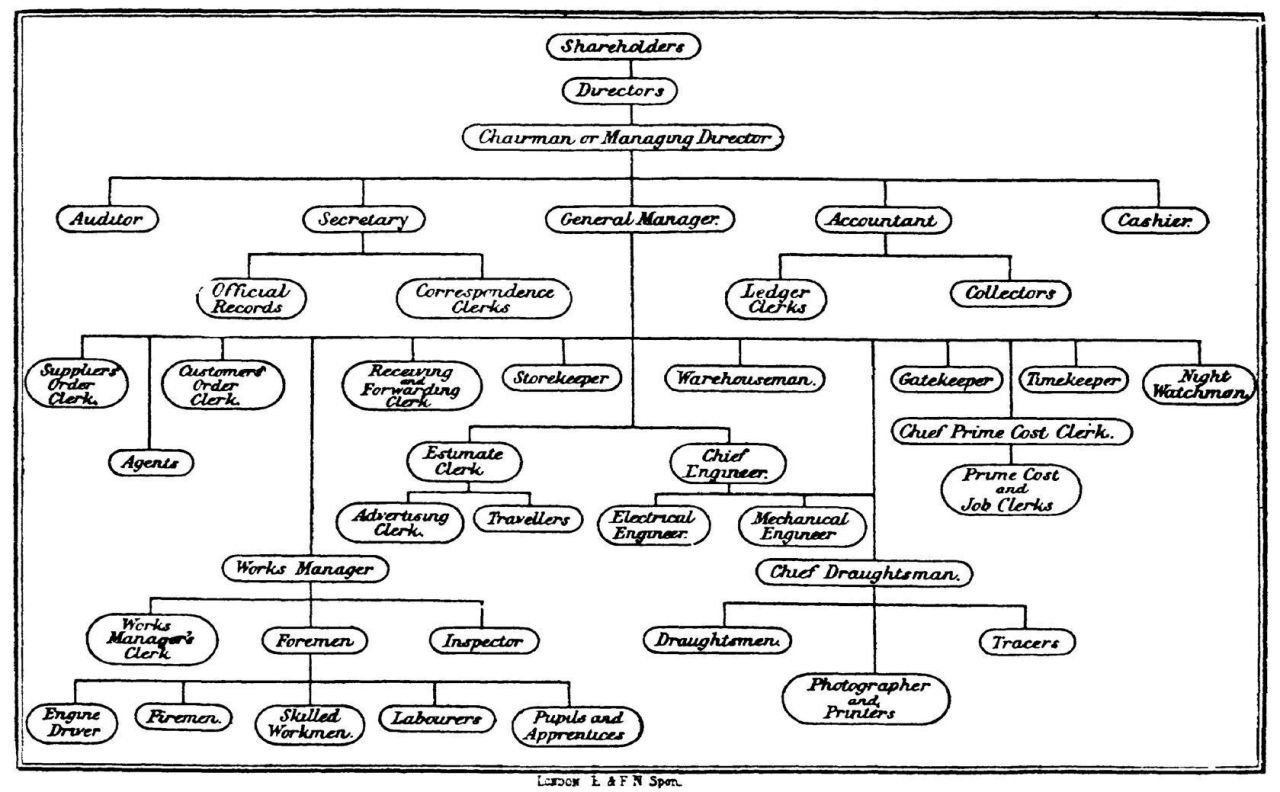
[image from J. Slater Lewis, 1896]
Regards, Jon


Reply